
For seven years, first on my own server then on Blogger, Lancaster Unity (formerly Lancaster UAF) has been fighting fascism and racism as embodied in such groups as the BNP and the EDL. From originally being set up to accompany local anti-fascist activity, the blog spread itself wider until it became a national resource with, over the years, many excellent contributors and countless thousands of readers.
When LU began, there was a gap in the market for a continually updated blog that has now been closed by a number of anti-fascist organisations elsewhere, some of which are listed below. Also, the advent and popularity of Twitter and Facebook (both easily accessible and updatable via smartphones) has made the anti-fascist presence on the internet much larger and more effective than it has ever been before. While the bad guys use technology to humiliate and embarrass themselves, anti-fascists have used it to inform and organise.
Because of ongoing health problems which are drastically eating into the time I can devote to Lancaster Unity, it has gradually become a copy and paste blog with very few original articles. This is no bad thing because it's always useful to have one type of news that appeals to a certain group located in a single place. This role though, is rapidly being superceded by Twitter, which does the same job very well. Better, in fact, than we ever could. Thus, it's time for Lancaster Unity to stand down, though the blog as it is will remain here as an archive and a resource for anti-fascists.
It's not too bad a time to be going. The EDL, although it has political ambitions, seems incapable of keeping itself from fragmenting in all directions, while the BNP at the moment appears to be shrinking by the day while Nick Griffin spends half his time in the European Parliament participating in the gravy train that he once professed to despise, and the other half boring us all to death with his tedious stories about smoked salmon.
Even better, it's a real pleasure to be leaving in the week that two of the killers of Stephen Lawrence have finally been convicted. We look forward to the day that the rest of them get banged up.
Big thanks to Denise and John, both of whom helped make LU what it was, and very many thanks to our contributors: Andy Minion, Iliacus, Roddy, Larry and all the rest of them. Special mentions go to NewsHound and Zaahid, both excellent news-spotters who should get their own sites together and keep up the good work. Naturally, a site such as this is useless without readers, and we've had a loyal and feisty readership over the years whose contributions have easily been as interesting as ours. Thank you to all of you (except the nazis, who are just complete morons).
We've been helped since the blog began by a number of organisations. Principal among these are Searchlight (who gave us essential help to get started in the first place, and who we worked closely with on numerous occasions), Hope not hate and Unite Against Fascism. Special thanks to those three and to all the other people who have helped out in one way or another.
It's been (at times) great fun, interesting and bloody hard work (especially on the all-night election specials). Thank you to everyone for all your input.
Although I have a good deal less time and energy these days, I shall be posting occasionally at my own blog space on Searchlight's new website. Thanks to Searchlight for offering me both the opportunity and the space. John has moved over to Anti-Fascists Online.
Ketlan
Lancaster Unity
This is not a comprehensive list of anti-fascist resources. If you think I've left anyone out who should be included, email me or make a comment and I'll add them.
Searchlight
Hope not hate
Unite Against Fascism
Anti-Fascists Online
EDL News
Everything EDL
Malatesta's Blog
Love Music Hate Racism
Show Racism the Red Card
EDL Watch at Urban75
HateWatch
Indymedia
Love Music Hate Homophobia
Liverpool Antifascists
Kick It Out
ICARE
Showing posts with label anti-fascist. Show all posts
Showing posts with label anti-fascist. Show all posts
January 12, 2012
December 09, 2010
Anti-fascists and British National Party members arrested after Liverpool clash
An investigation is underway after anti-fascist campaigners and British National Party supporters clashed in Liverpool.
Ten people were arrested following a violent fracas in Church Street on Saturday morning. The far-right party was collecting signatures on the city’s busiest shopping street when trouble flared. At around 10.45am, anti-fascist demonstrators and the BNP came head-to-head in aggressive scenes.
Three women and three men, who were holding a counter-rally against the political party, were detained. They were held on suspicion of criminal damage, affray and assault and taken to police stations in Merseyside. The women – 23, 22 and 21, from Aigburth, Toxteth and the city centre – and the men – 26, 25 and 24, from Birkenhead, Kensington and the city centre – were later released on bail pending further inquiries.
Two days later, three BNP activists were apprehended on suspicion of criminal damage and affray. The suspects, identified by the far-right group itself, are Peter Tierney, 53, from Hale Village, his brother Andrew, 44, from Huyton, and a woman, 59, from Wirral, were all released on bail. A man in his 50s or 60s was arrested shortly after the incident but will face no further action.
Both parties gave different accounts of the disturbance.
Liverpool Echo
Ten people were arrested following a violent fracas in Church Street on Saturday morning. The far-right party was collecting signatures on the city’s busiest shopping street when trouble flared. At around 10.45am, anti-fascist demonstrators and the BNP came head-to-head in aggressive scenes.
Three women and three men, who were holding a counter-rally against the political party, were detained. They were held on suspicion of criminal damage, affray and assault and taken to police stations in Merseyside. The women – 23, 22 and 21, from Aigburth, Toxteth and the city centre – and the men – 26, 25 and 24, from Birkenhead, Kensington and the city centre – were later released on bail pending further inquiries.
Two days later, three BNP activists were apprehended on suspicion of criminal damage and affray. The suspects, identified by the far-right group itself, are Peter Tierney, 53, from Hale Village, his brother Andrew, 44, from Huyton, and a woman, 59, from Wirral, were all released on bail. A man in his 50s or 60s was arrested shortly after the incident but will face no further action.
Both parties gave different accounts of the disturbance.
Liverpool Echo

 Labels:
Andrew Tierney,
anti-fascist,
BNP,
Liverpool Antifascists
Labels:
Andrew Tierney,
anti-fascist,
BNP,
Liverpool Antifascists
April 26, 2010
Police to release secret report on the death of Blair Peach
 Blair Peach died after being struck on the head at a demonstration against the NF
A highly critical report into the death of Blair Peach, the anti-fascist campaigner widely believed to have been killed by police in 1979, is expected to be published on Tuesday. Some 2,000 pages of documents will be released, including a previously secret police report. Peach, a 33-year-old teacher from New Zealand, died after being struck on the head at a demonstration against the National Front in Southall, west London. Witnesses said they saw him being attacked by police, but after an internal investigation no officers were charged.
It is understood the report has been redacted to protect the identities of individual officers. However, most interest is expected to focus on a report by commander John Cass, the Metropolitan police officer who investigated the death.
The Met agreed to release the report after Ian Tomlinson, a passerby at the G20 protests in London, died of internal bleeding last year after being attacked by a police officer. The incident, caught on film obtained by the Guardian, prompted comparisons with the Peach case.
At the April 1979 demonstration, more than 40 people, including 21 police, were injured and 300 were arrested. A pathologist report said Peach died from injuries likely to have been caused by a lead-weighted rubber cosh or hosepipe filled with lead shot. When officers' lockers were raided, unauthorised weapons including a metal cosh were found, but this was ruled out as the weapon that killed Peach.
Guardian
Labels:
anti-fascist,
Blair Peach,
demonstration,
G20,
Ian Tomlinson,
National Front
March 30, 2010
New anti-fascist network set up
The unity conference of anti-fascist activists held in Nottingham on Saturday 27 March resolved to create new national anti-fascist network based on a class-struggle approach. Representatives from campaigns which attended were nominated to serve on the committee, and other campaigns that gave their support for the conference but were unable to attend will be invited to send reps too.
Contact the new network via the Nottingham group on NottmStopBNP@yahoo.co.uk.
This network will build nationally, in cooperation with others when possible but if necessary independently of the the UAF, against BNP and EDL mobilisations; and share political material that can be used to counteract more effectively the EDL and the BNP across the country by dealing on a working-class basis with the social issues which the BNP and EDL feed on.
Over 50 anti-fascists attended the conference. Campaigns in several Midlands towns and cities, Yorkshire, Greater Manchester and Merseyside and London areas, and a number of trade union delegations, including from the RMT London Transport Region.
The conference opened with speeches from the president of NORSCARF (North Staffordshire Campaign against Racism and Fascism) on EDL activities in Stoke and from a representative of the Notts Stop the BNP campaign. Workshops were held on: combating the EDL; campaigning against the BNP; and working in the trade unions. Resolutions drafted by the Nottingham group were discussed and adopted after a number of minor amendments.
An emergency motion was also passed condemning the arrests made at the protest against the EDL’s provocation in Bolton on 20 March.
Workers' Liberty
Contact the new network via the Nottingham group on NottmStopBNP@yahoo.co.uk.
This network will build nationally, in cooperation with others when possible but if necessary independently of the the UAF, against BNP and EDL mobilisations; and share political material that can be used to counteract more effectively the EDL and the BNP across the country by dealing on a working-class basis with the social issues which the BNP and EDL feed on.
Over 50 anti-fascists attended the conference. Campaigns in several Midlands towns and cities, Yorkshire, Greater Manchester and Merseyside and London areas, and a number of trade union delegations, including from the RMT London Transport Region.
The conference opened with speeches from the president of NORSCARF (North Staffordshire Campaign against Racism and Fascism) on EDL activities in Stoke and from a representative of the Notts Stop the BNP campaign. Workshops were held on: combating the EDL; campaigning against the BNP; and working in the trade unions. Resolutions drafted by the Nottingham group were discussed and adopted after a number of minor amendments.
An emergency motion was also passed condemning the arrests made at the protest against the EDL’s provocation in Bolton on 20 March.
Workers' Liberty
Labels:
anti-fascist,
BNP,
EDL,
NORSCARF,
Notts Stop the BNP,
trade unions
March 27, 2010
MPs join forces in bid to fight the British National Party at the polls
Three of Portsmouth's leading politicians have agreed to unite against the BNP at the general election
While Mike Hancock, Sarah McCarthy-Fry and Flick Drummond may sit on opposing sides of the democratic divide, all have pledged to include anti-fascist messages on their election leaflets and communications. The pact was made last night at a meeting of Portsmouth Unite Against Fascism at which 130 people pledged their opposition to BNP candidate Geoff Crompton, who will stand in Portsmouth South at the next election.
It was estimated by organiser Simon Magorian as the biggest ever Portsmouth anti-fascist rally. He said: 'People of all ages and political opinions came. 'They know we can stop the fascists. I was at the Anti-Nazi League Portsmouth launch in 1977. This was bigger. It was the biggest ever.'
Mr Hancock and Ms McCarthy-Fry spoke, along with UAF national secretary Weyman Bennett and local group leaders. Conservative prospective parliamentary candidate for Portsmouth South Flick Drummond was in the audience, while Caroline Lucas, leader of the Green Party, sent apologies.
Ms McCarthy-Fry, Labour MP for Portsmouth North, said: 'We have weeks to debate party politics, but we're all united against the BNP. They pretend not to be racists, but very quickly their concern about crime turns into blaming it on asylum seekers.'
Mr Hancock, the Lib Dem Portsmouth South MP agreed: 'Its manifesto is about dividing communities. We stand together against them. We love our city - it's all about its diverse community. We will stand up for that, and for each other in the face of these bullies. We will all include clear messages on our communication that we oppose these fascists.'
Weyman Bennett said: 'The BNP is a fascist party attempting to win respectability. But we've already won an important battle. Its policies are racist but they fear to admit it in public. That's because people don't want to be associated with racism. Together, we can build on that.'
Lizzie Hug, 18, an art student from Portsmouth, said: 'The rise of the BNP scares me. Racist graffitti is springing up. We have to stand up against it. The UAF can make a difference and it's important people stand up to be counted.'
Paul Smitherman, 58, of Esslemont Road, Southsea, said: 'People here in Portsmouth look at who you are, not what colour your skin is. The BNP isn't a democratic party because they want to take away rights of people on the basis of what they look like. We have to take them on and show them their ideas are rubbish.'
The News
While Mike Hancock, Sarah McCarthy-Fry and Flick Drummond may sit on opposing sides of the democratic divide, all have pledged to include anti-fascist messages on their election leaflets and communications. The pact was made last night at a meeting of Portsmouth Unite Against Fascism at which 130 people pledged their opposition to BNP candidate Geoff Crompton, who will stand in Portsmouth South at the next election.
It was estimated by organiser Simon Magorian as the biggest ever Portsmouth anti-fascist rally. He said: 'People of all ages and political opinions came. 'They know we can stop the fascists. I was at the Anti-Nazi League Portsmouth launch in 1977. This was bigger. It was the biggest ever.'
Mr Hancock and Ms McCarthy-Fry spoke, along with UAF national secretary Weyman Bennett and local group leaders. Conservative prospective parliamentary candidate for Portsmouth South Flick Drummond was in the audience, while Caroline Lucas, leader of the Green Party, sent apologies.
Ms McCarthy-Fry, Labour MP for Portsmouth North, said: 'We have weeks to debate party politics, but we're all united against the BNP. They pretend not to be racists, but very quickly their concern about crime turns into blaming it on asylum seekers.'
Mr Hancock, the Lib Dem Portsmouth South MP agreed: 'Its manifesto is about dividing communities. We stand together against them. We love our city - it's all about its diverse community. We will stand up for that, and for each other in the face of these bullies. We will all include clear messages on our communication that we oppose these fascists.'
Weyman Bennett said: 'The BNP is a fascist party attempting to win respectability. But we've already won an important battle. Its policies are racist but they fear to admit it in public. That's because people don't want to be associated with racism. Together, we can build on that.'
Lizzie Hug, 18, an art student from Portsmouth, said: 'The rise of the BNP scares me. Racist graffitti is springing up. We have to stand up against it. The UAF can make a difference and it's important people stand up to be counted.'
Paul Smitherman, 58, of Esslemont Road, Southsea, said: 'People here in Portsmouth look at who you are, not what colour your skin is. The BNP isn't a democratic party because they want to take away rights of people on the basis of what they look like. We have to take them on and show them their ideas are rubbish.'
The News
January 29, 2010
Anti-fascist assaulted outside BNP court case
 Simon Assaf (centre) is dragged away by two of Griffin's group (Pic: Fil Kaler)
Two of Griffin’s group grabbed anti-fascist demonstrator Simon Assaf around the throat and head. His glasses were crushed into his face and he was left with cuts around his eyes. Simon was part of a protest organised by Unite Against Fascism outside the court.
 Simon Assaf had to go to hospital to have cuts around his eyes attended to (Pic: Fil Kaler)
Griffin scuttled away quickly by car.
Simon had to go to hospital to have the cuts around his eyes attended to. He added, “We did nothing wrong. Griffin has been found guilty of Holocaust denial and has been tried for inciting race hatred. The BNP thinks it can attack and injure people who are exercising their right to protest. If it does this in front of the press, I hate to think what it when no one is watching.”
The judge gave the BNP a further two weeks to amend its constitution before facing a possible court injunction.
Socialist Worker
May 24, 2009
The BNP's rise is a fantasy created by anti-democrats
The real cause of our anxieties is not the potential of the far right. It's the emergence of people power
Never underestimate how fast fear can swell in Britain. Sophisticated politicians and commentators analyse the "moral panics" of the masses about immigration and crime while remaining unaware of their own irrational prejudices. For in its nervous moments, polite society is just as panicky as the most hysterical tabloid reader. The veil of good manners slips and it describes its fellow citizens as tattooed and shaven-headed brutes who, given the right circumstances, would vote for the modern equivalent of the Nazi party.
The conditions ought to be right this summer. Indeed, I cannot imagine better conditions for a neo-fascist advance. Britain is coming to the end of the longest wave of immigration in her history. I argued when it was at its height that we could take a modest pride in the absence of rioting mobs and burning crosses, but I had to temper my patriotic sentiments with the admission that mass immigration came while the economy was booming and the public was more interested in shopping than taking to the streets. At the risk of stating the obvious, the boom is over. Unemployment is rising and anger at foreigners taking British jobs is rising with it.
To make matters worse - or better from the point of view of extremists - this parliament has disgraced itself. Its frauds turned Westminster into a tax haven and the House of Commons fees office into a cash machine that kept on giving. The electorate has gone from its normal state of surly acquiescence into a righteous fury.
Even before the scandal broke, no less an authority than the Archbishop of Canterbury warned that Britain needed to heed the lessons of Nazi Germany and accept "a very high risk of financial stringency leading to political extremes - anger finding its expression in xenophobia. The fact that the BNP can win a seat in Sevenoaks is a straw in the wind and we have to watch the horizon very, very carefully for the tempest that might be behind that".
I would mock him for imagining the leaders of the British National party crying: "Today Sevenoaks! Tomorrow the world!" But then it is just the kind of thing the leaders of the BNP would say and, in any case, the archbishop is hardly a lone voice. The combination of economic and political crises has led many politicians and journalists to predict sweeping BNP advances - five, six maybe seven European seats.
The party was hiding its roots in European fascism, they argued, and putting on respectable suits and friendly smiles to calm the electorate. It looked set to prosper.
I accept that it is foolish to call an election before a vote has been cast, and low turnouts can produce freak results, but the evidence that the BNP is surfing popular outrage is hard to find. On Thursday, the voters of Salford's Irwell Riverside ward ought to have given the far right an easy victory. If Salford is no longer Friedrich Engels's classic slum of "dirt and poverty", most of the ward's white, working-class voters still live in run-down terraces. Hazel Blears, Salford's Labour MP, did not share their struggles. She claimed for three different properties in one year, along with assorted televisions, beds, mattresses, curtains, pots, pans and overnight stays at one of London's chicest hotels.
After journalists worked out that she had managed to avoid capital gains tax after selling one home she had done up at public expense, she waved a cheque for £13,000 on television and announced she would send it to HM Revenue. Her gesture would have been less tactless if the idea of ever being in a position to write a cheque for £13,000 were not beyond the dreams of many of her constituents. Yet Blears stood at the count in Salford and saw Labour hold the seat. Its support was down, but despite the recession and the scandals, the BNP stayed stuck in third place, its share of the vote up a mere 3.8% on last year.
The anti-fascist campaigners, who gather around Searchlight magazine, were not surprised. They say that internal BNP documents show it to be a feeble organisation, running out of money and credible candidates. They do not think its strategy of dressing thugs in suits is working and nor do I. Not the least of the BNP's problems is that Nick Griffin was caught on camera at a meeting with the former Ku Klux Klan leader David Duke explaining how he would seek to con the public by using warm words - freedom, security, identity, democracy.
"Perhaps one day, once by being rather more subtle we've got ourselves in a position where we control the British broadcasting media, the British people might change their mind and say, 'Yes, every last one must go.' But if you offer that as your sole aim to start with, you're gonna get absolutely nowhere. So, instead of talking about racial purity, we talk about identity."
Griffin has fooled the occasional journalist, but the regular convictions of BNP members for racial assaults, drug dealing and sex crimes leave most people in no doubt that the new BNP is no different from the old BNP: an alliance of criminals with criminal policies. If it fails to break through even in these propitious circumstances, however, it will still have revealed a latent prejudice in the British elite.
Alongside honourable concerns lurks a suspicion of popular power. Listen carefully whenever proposals are discussed to improve local democracy by, say, electing chief constables and police authorities. Eventually, an authoritative voice will tell you that the British cannot be trusted with more power because they may let the BNP take over the police forces. Similarly with reforms to the national voting system. Once again, we are told that a fairer election system cannot be contemplated because it will let the BNP out of its cage.
The best reason for hoping that it is trounced is not that a vile party will have gone down to a deserved defeat, but because it will make it harder for the opponents of reform to argue that their fellow citizens are nasty children whose betters cannot allow them to run their own affairs.
Comment is free
Never underestimate how fast fear can swell in Britain. Sophisticated politicians and commentators analyse the "moral panics" of the masses about immigration and crime while remaining unaware of their own irrational prejudices. For in its nervous moments, polite society is just as panicky as the most hysterical tabloid reader. The veil of good manners slips and it describes its fellow citizens as tattooed and shaven-headed brutes who, given the right circumstances, would vote for the modern equivalent of the Nazi party.
The conditions ought to be right this summer. Indeed, I cannot imagine better conditions for a neo-fascist advance. Britain is coming to the end of the longest wave of immigration in her history. I argued when it was at its height that we could take a modest pride in the absence of rioting mobs and burning crosses, but I had to temper my patriotic sentiments with the admission that mass immigration came while the economy was booming and the public was more interested in shopping than taking to the streets. At the risk of stating the obvious, the boom is over. Unemployment is rising and anger at foreigners taking British jobs is rising with it.
To make matters worse - or better from the point of view of extremists - this parliament has disgraced itself. Its frauds turned Westminster into a tax haven and the House of Commons fees office into a cash machine that kept on giving. The electorate has gone from its normal state of surly acquiescence into a righteous fury.
Even before the scandal broke, no less an authority than the Archbishop of Canterbury warned that Britain needed to heed the lessons of Nazi Germany and accept "a very high risk of financial stringency leading to political extremes - anger finding its expression in xenophobia. The fact that the BNP can win a seat in Sevenoaks is a straw in the wind and we have to watch the horizon very, very carefully for the tempest that might be behind that".
I would mock him for imagining the leaders of the British National party crying: "Today Sevenoaks! Tomorrow the world!" But then it is just the kind of thing the leaders of the BNP would say and, in any case, the archbishop is hardly a lone voice. The combination of economic and political crises has led many politicians and journalists to predict sweeping BNP advances - five, six maybe seven European seats.
The party was hiding its roots in European fascism, they argued, and putting on respectable suits and friendly smiles to calm the electorate. It looked set to prosper.
I accept that it is foolish to call an election before a vote has been cast, and low turnouts can produce freak results, but the evidence that the BNP is surfing popular outrage is hard to find. On Thursday, the voters of Salford's Irwell Riverside ward ought to have given the far right an easy victory. If Salford is no longer Friedrich Engels's classic slum of "dirt and poverty", most of the ward's white, working-class voters still live in run-down terraces. Hazel Blears, Salford's Labour MP, did not share their struggles. She claimed for three different properties in one year, along with assorted televisions, beds, mattresses, curtains, pots, pans and overnight stays at one of London's chicest hotels.
After journalists worked out that she had managed to avoid capital gains tax after selling one home she had done up at public expense, she waved a cheque for £13,000 on television and announced she would send it to HM Revenue. Her gesture would have been less tactless if the idea of ever being in a position to write a cheque for £13,000 were not beyond the dreams of many of her constituents. Yet Blears stood at the count in Salford and saw Labour hold the seat. Its support was down, but despite the recession and the scandals, the BNP stayed stuck in third place, its share of the vote up a mere 3.8% on last year.
The anti-fascist campaigners, who gather around Searchlight magazine, were not surprised. They say that internal BNP documents show it to be a feeble organisation, running out of money and credible candidates. They do not think its strategy of dressing thugs in suits is working and nor do I. Not the least of the BNP's problems is that Nick Griffin was caught on camera at a meeting with the former Ku Klux Klan leader David Duke explaining how he would seek to con the public by using warm words - freedom, security, identity, democracy.
"Perhaps one day, once by being rather more subtle we've got ourselves in a position where we control the British broadcasting media, the British people might change their mind and say, 'Yes, every last one must go.' But if you offer that as your sole aim to start with, you're gonna get absolutely nowhere. So, instead of talking about racial purity, we talk about identity."
Griffin has fooled the occasional journalist, but the regular convictions of BNP members for racial assaults, drug dealing and sex crimes leave most people in no doubt that the new BNP is no different from the old BNP: an alliance of criminals with criminal policies. If it fails to break through even in these propitious circumstances, however, it will still have revealed a latent prejudice in the British elite.
Alongside honourable concerns lurks a suspicion of popular power. Listen carefully whenever proposals are discussed to improve local democracy by, say, electing chief constables and police authorities. Eventually, an authoritative voice will tell you that the British cannot be trusted with more power because they may let the BNP take over the police forces. Similarly with reforms to the national voting system. Once again, we are told that a fairer election system cannot be contemplated because it will let the BNP out of its cage.
The best reason for hoping that it is trounced is not that a vile party will have gone down to a deserved defeat, but because it will make it harder for the opponents of reform to argue that their fellow citizens are nasty children whose betters cannot allow them to run their own affairs.
Comment is free
Labels:
anti-fascist,
BNP,
David Duke,
Ku Klux Klan,
nazi,
Nick Griffin,
Searchlight,
xenophobia
January 01, 2009
Happy 2009 from all at Lancaster Unity!
 A happy, peaceful and prosperous 2009 to all our anti-fascist readers
Starting tomorrow, we begin our review of 2008, a pretty eventful year all round - and we get on with 2009 and whatever joys and sorrows it has waiting for us. It's going to be a busy year for all of us, so relax for the moment and remind yourselves of the highs and lows of 2008.
Labels:
2008,
2009,
anti-BNP,
anti-fascist,
Lancaster Unity
December 23, 2008
At last, the Searchlight covers...
As promised a couple of months back when Searchlight celebrated its 400th edition, we've got a selection of front covers from the past thirty years for you to take a look at. It's been a bugger trying to work out how to do tables on the blog so the pictures would display properly, then someone suggested Picassa, which worked very nicely indeed. So here they are at last. Click on the image and take a look...
 |
| Searchlight Covers |
Labels:
anti-fascist,
Picassa,
Searchlight,
Searchlight covers
October 08, 2008
400 and not out - Searchlight celebrates its 400th edition (part one)
The fighting 400 - Gerry Gable looks back at the early days of Searchlight
When Searchlight first appeared as a magazine in February 1975 it already had a strong track record. Between 1965 and 1968 Searchlight was published as an occasional broadsheet which campaigned against racism and fascism from a somewhat liberal perspective but, unlike the magazine today, made little use of the intelligence being gathered about the far right and its activities.
After two excellent editors, the Labour MPs Reg Freeson and Joan Lester MP, who left to take up Cabinet posts in the Wilson Government as Housing Minister and Minister for Overseas Aid respectively, it fell to me, Searchlight’s research editor, to take up the baton.
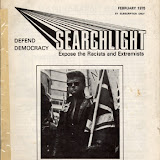
 Issue 1: February 1975
Like some other anti-fascists and anti-racists at the time, I felt that the paper was not having the right impact. So I closed it down, replacing it by a press bureau that produced occasional bulletins and booklets and rapidly built national and international links with likeminded people.
Searchlight became the first port of call for print, TV and radio journalists writing about the National Front in the 1970s, which grew to 17,500 members ranging from hardline nazis to Tory diehards united in their racism and antisemitism.
In late 1974 we published a booklet surveying Britain’s far right partly to test the market for this type of information. A well oiled nazi machine sold like hot cakes and three months later the magazine was launched.
A bit tatty and often ungrammatical, it was produced by a small team based in Birmingham and Essex and prepared often as not on my kitchen table. From the first issue it was led by the mounting intelligence coming in from inside the far right here and abroad.
Essentially the magazine had four aims. The first was to investigate and expose, by analysing and using the intelligence we gathered from the highest echelons of the NF and even more extreme groups. Information from our own trained intelligence operatives, whom we infiltrated into the far right, was complemented by a stream of defectors who had lost their faith in fascism and racism or sought some personal or political gain.
Our second aim was to publish news stories about far-right activities which attracted media interest and caught the imagination of the anti-racist and anti-fascist movement.
The third was to educate. Maurice Ludmer, a trade unionist who became president of Birmingham Trades Council, then the biggest body of its kind in Western Europe, worked with me from the 1960s and edited the magazine until he died in 1981. Maurice saw the vital need for education and from his experience in the earliest postwar anti-racist campaigns coined the phrase, still so important today, “We must teach anti-racists to be anti-fascist and anti-fascists to be anti-racist”.
 Issue 43: January 1979
Our final aim was to use our knowledge to help the broadest body of anti-fascists to build a non-sectarian movement.
The magazine very quickly gained a reputation as the primary source for anyone who wanted to know about the extreme right and over the years published hundreds of groundbreaking investigations and news stories, as well as more analytical articles staking out the ground for resistance to racism and fascism.
The early years saw some spectacular successes through the work of some very brave individuals who worked under great pressure and risk to expose the truth about the enemies of democracy. Many cannot be named here, some are still active, but one of the most high profile was Ray Hill.
A onetime violent follower of Britain’s nazi leader Colin Jordan, he experienced a slow but complete change of heart while living in South Africa. He contacted us after he returned to Britain and for the next few years worked for us deep among the nazi terrorists both here and in Europe.
While still under cover he made a World in Action television documentary about British nazis armed with guns and explosives. Almost single-handedly he destroyed the extreme nazi British Movement, setting it back for years. He completely destroyed the British Democratic Party and its leader, the Leicester solicitor Anthony Reed Herbert, and was on the top table when John Tyndall set up the British National Party.
Ray went on to make a series of TV documentaries and wrote a book with Andrew Bell, the producer of the programmes.
Maurice built up a great deal of goodwill in the trade union movement though nothing on the scale of our trade union support today. He assembled a formidable team of writers, many serious, some humorous – yes we have always seen humour as a vital weapon against bigots.
The playwright David Edgar thanked us for our help with his first major play, Destiny, and rewarded us with many excellent columns in the magazine. Professor Michael Billig, a leading social psychologist, wrote regularly for the magazine as did many others who have gone on to become leading journalists.
After Maurice’s untimely death in 1981, various people took charge until my return as editor in 1983. I stood down in 1999 handing over to Steve Silver and Nick Lowles as joint editors, but remained as publisher. In 2005 Nick became the sole editor.
Searchlight
Part 2 tomorrow...
When Searchlight first appeared as a magazine in February 1975 it already had a strong track record. Between 1965 and 1968 Searchlight was published as an occasional broadsheet which campaigned against racism and fascism from a somewhat liberal perspective but, unlike the magazine today, made little use of the intelligence being gathered about the far right and its activities.
After two excellent editors, the Labour MPs Reg Freeson and Joan Lester MP, who left to take up Cabinet posts in the Wilson Government as Housing Minister and Minister for Overseas Aid respectively, it fell to me, Searchlight’s research editor, to take up the baton.
 Issue 1: February 1975
Searchlight became the first port of call for print, TV and radio journalists writing about the National Front in the 1970s, which grew to 17,500 members ranging from hardline nazis to Tory diehards united in their racism and antisemitism.
In late 1974 we published a booklet surveying Britain’s far right partly to test the market for this type of information. A well oiled nazi machine sold like hot cakes and three months later the magazine was launched.
A bit tatty and often ungrammatical, it was produced by a small team based in Birmingham and Essex and prepared often as not on my kitchen table. From the first issue it was led by the mounting intelligence coming in from inside the far right here and abroad.
Essentially the magazine had four aims. The first was to investigate and expose, by analysing and using the intelligence we gathered from the highest echelons of the NF and even more extreme groups. Information from our own trained intelligence operatives, whom we infiltrated into the far right, was complemented by a stream of defectors who had lost their faith in fascism and racism or sought some personal or political gain.
Our second aim was to publish news stories about far-right activities which attracted media interest and caught the imagination of the anti-racist and anti-fascist movement.
The third was to educate. Maurice Ludmer, a trade unionist who became president of Birmingham Trades Council, then the biggest body of its kind in Western Europe, worked with me from the 1960s and edited the magazine until he died in 1981. Maurice saw the vital need for education and from his experience in the earliest postwar anti-racist campaigns coined the phrase, still so important today, “We must teach anti-racists to be anti-fascist and anti-fascists to be anti-racist”.
 Issue 43: January 1979
The magazine very quickly gained a reputation as the primary source for anyone who wanted to know about the extreme right and over the years published hundreds of groundbreaking investigations and news stories, as well as more analytical articles staking out the ground for resistance to racism and fascism.
The early years saw some spectacular successes through the work of some very brave individuals who worked under great pressure and risk to expose the truth about the enemies of democracy. Many cannot be named here, some are still active, but one of the most high profile was Ray Hill.
A onetime violent follower of Britain’s nazi leader Colin Jordan, he experienced a slow but complete change of heart while living in South Africa. He contacted us after he returned to Britain and for the next few years worked for us deep among the nazi terrorists both here and in Europe.
While still under cover he made a World in Action television documentary about British nazis armed with guns and explosives. Almost single-handedly he destroyed the extreme nazi British Movement, setting it back for years. He completely destroyed the British Democratic Party and its leader, the Leicester solicitor Anthony Reed Herbert, and was on the top table when John Tyndall set up the British National Party.
Ray went on to make a series of TV documentaries and wrote a book with Andrew Bell, the producer of the programmes.
Maurice built up a great deal of goodwill in the trade union movement though nothing on the scale of our trade union support today. He assembled a formidable team of writers, many serious, some humorous – yes we have always seen humour as a vital weapon against bigots.
The playwright David Edgar thanked us for our help with his first major play, Destiny, and rewarded us with many excellent columns in the magazine. Professor Michael Billig, a leading social psychologist, wrote regularly for the magazine as did many others who have gone on to become leading journalists.
After Maurice’s untimely death in 1981, various people took charge until my return as editor in 1983. I stood down in 1999 handing over to Steve Silver and Nick Lowles as joint editors, but remained as publisher. In 2005 Nick became the sole editor.
Searchlight
Part 2 tomorrow...
Labels:
400,
anti-fascist,
Gerry Gable,
Joan Lester,
Maurice Ludmer,
National Front,
Reg Freeson,
Searchlight
May 06, 2008
Anti-BNP campaigners' personal details put on website
 Redwatch boss, the moronic nazi Kevin Watmough
Redwatch posts details of what it says are Marxists and Communists, including home addresses and telephone numbers, stating they should 'pay for their crimes'.
Following an anti-BNP rally in Wrexham town centre on April 12, photos and personal information about a number of local people, including MPs, councillors and anti-fascist campaigners, were put up on the website. But a number of those targeted, including Wrexham Council's Liberal Democrat leader, say they are unperturbed by the move.
Wrexham's Lib Dem leader, Aled Roberts, who took part in the demonstration, said: "As far as I'm concerned I've got no problem with anyone knowing my details – my phone number is in the directory. If a right wing organisation puts my details up as some kind of quasi-Communist I'm happy with that. It's a free country and I've got a right to express my views."
County councillor David Bithell added: "If they have got me on the website as far as I'm concerned it is a badge of honour. I'm delighted I'm on there."
A slogan, which appears on Redwatch's homepage, reads: "Remember places, traitors' faces, they'll all pay for their crimes."
Evening Leader
Note: To join Searchlight's campaign to shut down Redwatch, go here.
Labels:
anti-BNP,
anti-fascist,
Redwatch,
Wrexham
February 11, 2008
Lancaster UAF becomes Lancaster Unity
Unite Against Fascism, like the former Anti-Nazi League, rightly began as a temporary alliance against resurgent fascism. However, since then, BNP councillors have unfortunately become part of the landscape. Various groups, including Lancaster UAF, have continued to oppose them between and beyond particular campaigns.
The shorter name, 'Lancaster Unity', will express continued opposition to racist division, reflecting our united work with other anti-fascist groups whose names and approaches differ, and points beyond anti-fascism towards racial unity. For these reasons, we will adopt the new name from today.
Please note: the blog will remain in the same location (at least for the foreseeable future).
The shorter name, 'Lancaster Unity', will express continued opposition to racist division, reflecting our united work with other anti-fascist groups whose names and approaches differ, and points beyond anti-fascism towards racial unity. For these reasons, we will adopt the new name from today.
Please note: the blog will remain in the same location (at least for the foreseeable future).
Labels:
anti-fascist,
Lancaster UAF,
Lancaster Unity
January 30, 2008
Jan Kucera - Another victim of neo-nazis
 About one thousand people gathered on 19 January, 2008 in Pilsen, Czech Republic, to commemorate the victims of nazi terror: 66 years ago, Jews from Pilsen were deported to concentration camps, but nobody knew that another victim of current neo-nazi violence is at the very same time fighting for his life in a hospital.
On 18 January in Pribram, a town 50 km south-west of Prague, 20-year-old neo-nazi Jiri Fous stabbed 18-year-old Jan Kucera in the groin and back about an hour to midnight. Before this attack, young local neo-nazis were provoking with nazi salutes and offending a group of young punks and antifascist skinheads, to which Jan belonged. Jan’s friends were trying to stop the bleeding from his femoral artery and called for an ambulance. Neither the paramedics nor Jan’s friends realized that Jan had also been stabbed in the back before it was too late. Jan lost massive amounts of blood and fell unconscious. He was rushed to a nearby hospital, but even though he was in the hands of professional doctors, he died on Sunday morning.
Jan Kucera was an antifascist skinhead from Pribram, and he was never afraid to express his opinions. In his Internet profile, he wrote: "I’m a normal boy and I consider myself a SHARP skinhead. I don’t care who my friends are - I don’t judge people because of their musical taste, their clothes or the colour of their skin. I judge people by what they do. Anybody can write to me. I hate nazis, the bourgeoisie, communists and similar scum! Antifascista Oi!"
He stood by his opinions until the very end. He will stay forever in the hearts of his family, friends, and all people with an antifascist attitude. Honour to his memory.
Antifa.cz
January 14, 2008
For a working class campaign against fascism
Effective anti-fascist campaigning must encourage genuine non-racist action for working class interests on housing, employment and welfare rights; and promote non-racist democratic working class organisations, such as trade unions, to organise around such issues.
“Only one thing could have stopped our movement — if our adversaries had understood its principle and intentions and from the first day had smashed with the utmost brutality the nucleus of our new movement.” Adolf Hitler, Mein Kampf
“To bar the road to fascism, to bar it once and for all, it does not suffice that workers oppose it physically at demonstrations; it does not suffice to denounce its infamies … Today we defend ourselves against the rise of reaction, but … to be efficacious this resistance must transform itself into a struggle for power.” Leon Trotsky, ‘Conversations with a Dissident from Saint-Denis’
In the 2005 general election 192,746 people voted for the British National Party. Each of the BNP’s 119 candidates received an average of 1620 votes. On local election polling day, 3 May 2007, the BNP received 292,911 votes — a ninety-seven fold increase since the year 2000. Over the last four years the BNP has doubled the number of councils where it contests seats and has quadrupled the number of candidates. As of the last local elections, the BNP held fifty council seats.
Election results can tell us some things. On the surface these figures show an increasing return on an ever increasing number of BNP candidates. They stand as evidence that given the choice between a Labour candidate, a Tory or whoever else, large numbers of people are prepared to tick the box for a fascist. Election results act as a warning to working class organisations that something is going on. They do not tell us what that is or how to combat it.
British fascists have made great efforts to transform themselves from a group oriented to street agitation, outright racism and anti-Semitism, threat and intimidation into a “legitimate” political operation. Though they still lurk in the shadows, the shaven headed, jack-booted, monosyllabic thugs have all but vanished from the limelight. They have been replaced by slicker, populist political operators — people like Sadie Graham and newly “media-friendly” Nick Griffin. But a new suit and toned-down rhetoric do not make for a complete transformation. The still rumbling crisis in the BNP has publicly exposed the true nature of the group. With each side in the dispute calling the other “Nazis” and “extremists” the liberal media and anti-fascist news sources have had a field day. Few have paused to ask how such an organisation has built a base of support and grown so rapidly in so short a space of time.
The relative success of the BNP cannot be isolated to a parting of ways with past fascist political methodology. In previous periods of right-wing resurgence where fascist groups rose from the sewers, subjective as much as objective circumstances played a part in flushing them away. In the 1930s and 40s Oswald Mosley’s British Union of Fascists faced stubborn, heroic resistance from working class and Jewish organisations. In the mid-to-late Seventies, when the National Front could claim a membership of 20,000 and managed to circulate five million leaflets in one year, mass political, community and cultural mobilisations — not exclusively called by the Anti Nazi League — drove fascists from the streets. Today’s anti-fascist groups are a pale imitation of the past and the absence of militant working class opposition to fascism is a pressing concern.
The working class, Labour and the BNP
“The enemies of British Nationalism continue to parrot the claim that the BNP is a ‘racist party.’ This claim is most often repeated because the BNP unashamedly addresses itself to the issues and concerns of the indigenous British population, and because it seeks to ensure that British people remain the majority population in this country.” (Is the BNP Racist? from the BNP website)
The BNP no longer appeals to working class voters on the basis of outspoken race-hate alone. A change in social and cultural attitudes means that crude racism is not acceptable to a majority of people. The fact that the labour movement has never tackled racism in a consistent and wholesale way means that residual — but deeply held — racist attitudes are there to be exploited.
The BNP does this by conflating very real working class concerns with the presence of minority and immigrant populations. They claim to be defending the interests of an “indigenous population” who suffer from unemployment, poor housing, health and education services because “immigrants” are either given preferential treatment or “flood” an area in overwhelming numbers. Gordon Brown recently jumped on this band-wagon when he shamefully promised the following to a meeting with the GMB union:
“It is time to train British workers for the British jobs that will be available over the coming few years and to make sure that people who are inactive and unemployed are able to get the new jobs on offer in our country.”
Had this statement appeared without credit most people would assume it spilled forth from the mouth of Nick Griffin, not a Labour Prime Minister. Since 1997 this Labour government has pursued a hard-line policy of attacking asylum seekers and immigrants. They are scapegoated by the right wing press and the government reacts by issuing ever more draconian policy statements. Rather than tackle head-on the racist myths spread by the Daily Mail and BNP, the Labour Party of Tony Blair and Gordon Brown has pandered to them.
This strategy has a duel effect: it gives political cover for the very real failings of the Labour Party over the past ten years and legitimises the political message of extreme right-wingers and the fascist BNP.
The BNP has built a base and made electoral advances in predominantly working class areas where the wilful neglect and attacks of this government find concrete material expression. Child poverty, inadequate housing, homelessness, insufficient public services – from health through to education provision – remain everyday realities in British society. Those in work face poor conditions and pay. In the absence of a combative trade union movement and the presence of a legal framework that militates against the emergence of class-wide solidarity, workers are effectively abandoned. Add to this the emasculated local structures of the Labour Party and wider labour movement — the traditional means by which working people expressed their concerns and fought for change — and we have a situation ripe for fascist agitation.
Recent BNP propaganda — both locally produced and in national publications – focuses upon “explaining” the crisis in jobs, housing and public services. For instance, in an article headlined “NHS at Breaking Point” the BNP blamed the crisis in the NHS not on under funding but on Polish immigrants who have “poured” into Britain. Are the BNP lying when they point out problems in public services? No, but the spin they put upon such problems is political poison. An anti-fascist campaign that either ignores such issues or focuses upon the “positive aspects” of society fails to address the real questions and concerns of the working class.
Unite Against Fascism and Searchlight
Unite Against Fascism (UAF) and the Searchlight organisation — a group that produces a monthly anti-fascist magazine and runs some local campaign groups — have major political faults. UAF is essentially a political coalition of the Socialist Workers Party and Socialist Action — a small Stalinist sect close to Ken Livingstone. It claims the support of most major trade unions and a variety of religious organisations. The political foundations of UAF are built upon the SWP’s interpretation of the United Front tactic. Leon Trotsky outlined the basis and need for a united front as follows:
“So long as it does not hold this majority [of the working class], the [revolutionary] party must fight to win it. The party can achieve this only by remaining an absolutely independent organisation with a clear program and strict internal discipline. That is the reason why the party was bound to break ideologically and organisationally with the reformists and the centrists who do not strive for the proletarian revolution, who possess neither the capacity nor the desire to prepare the masses for revolution, and who by their entire conduct thwart this work … But it is perfectly self-evident that the class life of the proletariat is not suspended during this period preparatory to the revolution. Clashes with industrialists, with the bourgeoisie, with the state power, on the initiative of one side or the other, run their due course. In these clashes — insofar as they involve the vital interests of the entire working class, or its majority, or this or that section — the working masses sense the need of unity in action, of unity in resisting the onslaught of capitalism or unity in taking the offensive against it. Any party which mechanically counterposes itself to this need of the working class for unity in action will unfailingly be condemned in the minds of the workers” (my emphasis).
Revolutionary socialists advocate the formation of a united front to fight for working class interests on the basis of unity between established working-class organisations. Trotsky advocated such a tactic to counter the rise of fascism in Germany in the 1930s. In practice the SWP denudes the united front of its essential working class orientation. For example:
Q. Does UAF practically unite working class organisations?
A. If all Trotsky means by unity is getting trade union general secretaries to sign a piece of paper, then yes – but this is not what Trotsky meant. For socialists, “unity” means a unified and purposeful action. UAF “appears” when the SWP thinks it politically expedient to roll it out. This means either turning SWP branches to anti-fascist activity at election times or turning out leading members for protests and conferences. There is no evidence of work towards major mobilisations of trade union members. No joint initiatives above the printing of T-Shirts and balloons. No practical unity.
Q. Are socialists “politically independent” inside UAF?
A. It is not possible for the SWP to be politically independent without tearing UAF apart. Sir Iqbal Sacranie — chair of the Muslim Council of Britain (MCB) — was invited as a headline speaker to UAF’s 2006 national conference. Bad enough that the MCB has reactionary Islamist politics. Add to this Sir Iqbal’s appearance on Radio Four where he labeled LGBT people as immoral, harmful and responsible for spreading disease and you see just how far the SWP will go to “unite” people. For them, the united front has no class content.
Q. But the SWP has a record of working hard against fascism.
A. This is true but the “work” they do is politically bankrupt. The following appeared on a recent UAF election leaflet: “Far right extremist groups are seeking to exploit the traditional low turnout at local elections to make inroads on 4 May and have provocatively described the elections as a ‘Referendum Day on Islam’. The MCB urges all people of goodwill to vote in the 4 May elections to ensure that fascist groups are comprehensively defeated at the ballot box.” Nothing much wrong with this statement: it’s right to point out the racist politics of the BNP and urge people to vote against them — no problems here. Except that this is all the leaflet has to say, and the man saying it is an outspoken homophobe — Sir Iqbal Sacranie. If anti-fascist propaganda fails to take up working class concerns, then it fails the working class.
Searchlight originates in a magazine published by Labour MPs Reg Freeson and Joan Lestor in the 1960s. After the magazine folded in 1967, Gerry Gable — who remains a central figure in the group — maintained a small organisation. It eventually began publishing again in 1975, when the National Front became a significant presence.
The main activity of the group remains collecting and exposing information on the far right with a focus on Britain. In addition to this important work — which seems to involve maintaining a network of infiltrators — Searchlight runs the “Stop the BNP” campaign group.
Stop the BNP has a much healthier approach to building local groups and relating to local issues than UAF. For example, the “Keighley Together” group ran a very successful, grass-roots response to BNP activity in their town.
But the campaign materials produced by Searchlight leave a great deal to be desired. Where UAF has a rabid homophobe, Stop the BNP has Alan Sugar, who appeared in material produced for the 2007 local elections. Alan Sugar has nothing to say about poorly funded public services and attacks on the working class. “Hope Not Hate” is the main political message of Stop the BNP materials — rather than relating to real issues and offering working class solutions, there is a preference for accentuating the positive. It is an inadequate response to the opportunism of the BNP in its current phase.
A rational response to the current phase of BNP activity must combine the sort of work carried out by Stop the BNP — the creation of grass-roots groups that campaign on local issues — together with a serious work in the trade unions.
Working class anti-fascism in the 1940s and 1970s
The history of working class anti-fascism in Britain is often hidden behind stories of mass street protests and rock concerts. But the organised working class has played a central role in disabling fascist political initiatives in the past. In the two periods where British fascist organisations gained some prominence – in the mid-to-late 1940s and 1970s — trade unions lobbied, organised and mobilised their memberships against them.
The immediate post-war period saw the emergence of small fascist propaganda groups. In spite of Hitler’s defeat and a growing public appreciation of the horrors of Nazi Germany, these groups held street meetings, mass leaflet drops and agitated their politics at every opportunity. The release of Oswald Mosley from wartime internment in 1943 encouraged the remnants of his British Union of Fascists on the offensive.
An indication of the level of trade union involvement comes from a collection of 302 letters sent to the Home Office between January 1945 and December 1948. According to Dave Renton (a semi-official historian of anti-fascist campaigning), of the 302 letters asking the Labour government to act against the Mosleyites, one third came from trade union branches. “If we were to add the letters from groups of workers and socialist organisations, from tenants’ associations and from individuals rooted in working-class campaigns, the proletarian aspect would represent a clear majority” (Renton).
The signing of a letter is hardly an indication of militant anti-fascism — especially when the letters in question called upon the Home Secretary to impose state bans on fascist groups — but post-war anti-fascism was not a letter writing campaign. Fascism became a central concern of trades council and shop steward groups. They politically educated members on the dangers of fascism, encouraged them to keep watch for activity and in Birmingham formed an “anti-fascist league”.
The Anti-Nazi League (ANL) of the 1970s claimed the support of “30 branches of the AUEW engineers union, 25 trades councils, 13 shop stewards committees, 11 NUM lodges, and similar numbers of branches from the TGWU, CPSA, TASS, NUJ, NUT and NUPE” (Renton). Some unions set up their own campaign groups, for instance the NUM held a “Miners Against the Nazis” conference in 1979.
What these two examples show is the latent potential of trade unions to mobilise anti-fascist sentiment — to engage in working-class politics. In both cases the relationship between different wings of the Labour Party and the far-left (the CPGB in the 1940s and SWP in the 1970s) produced some very uneven outcomes. On the one hand the Labour right wing took a naturally conservative approach to such a campaign. Inside the unions they attempted to stem the influence of Communists and Trotskyists by restricting access to young members’ conferences, for example. The political methods of postwar Stalinism and the Socialist Workers Party alienated a good many activists.
The current tactics of the BNP make a labour movement based campaign all the more important. It is not just a case of mobilising large numbers of people to protest against fascists but of providing political ideas and organisational structures to address working class concerns.
The anti-fascist campaign we need
The BNP characterises the current period as the start of a “quiet revolution”. They claim to speak for a “silent majority” of people abandoned by the major political parties and excluded from the gains of wider society. As “Proud Nationalists” they defend the “indigenous” people of this country against the threat posed by “ethnics” and “reds”.
Through hard work and a tactical change of direction the BNP has built serious local organisations that work hard to relate to local, working class concerns. In areas where the Labour Party has all but collapsed and where trade unions have few organic links in communities, BNP branches can be the only political operations relating to people’s concerns. In many areas the situation is desperate.
We who oppose fascism do so primarily because we value freedom: freedom of speech, the freedom to organise and the freedom to protest. The BNP’s freedom to operate is freedom to organise intimidation, as well as to spread violence and race hate. We defend the free speech of those who fight for positive non-racist changes to society as well as the freedom of traditionally victimised sections of our communities against the threat of fascist organisations such as the BNP. The BNP attempts to penetrate social movements and trade unions; and to take elected positions as councillors. They do this in order to foment division and racism as well as to identify their opponents and look for ways of intimidating them. We therefore advocate
• That the BNP should not be given any recognition as deserving a place in any genuine democratic debate.
• That all community organisations — but particularly trade unions and councils — do their utmost to isolate and remove them from their midst; thus preventing them from using any democratic façade behind which to organise.
• That as far as possible BNP activities should be blocked by mass pickets and mobilisations of local communities backed by the radical and trade union movement.
The BNP pretend to be a party of working class protest; at times even to be left wing critics of the Labour government. What is worse is that many people vote for them believing this to be true. We cannot allow the BNP to continue to peddle this monstrous lie.
It is an essential aspect of effective anti-fascist campaigning therefore that we
• encourage genuine non-racist action for working class interests on housing, employment and welfare rights as well as
• promoting non-racist democratic working class organisations, such as trade unions, to organise around such issues.
We need a united anti-fascist campaign in which a diversity of views are welcome but we need to build a campaign that does not compromise the work of our constituent organisations and campaigns in taking up such issues.
Such a campaign — mobilising the labour movement with consistent working class politics — will not only challenge the threats and lies of the fascist BNP but go some way to re-educating our class with socialist ideas.
Author: Charlie Salmon
Worker's Liberty
“Only one thing could have stopped our movement — if our adversaries had understood its principle and intentions and from the first day had smashed with the utmost brutality the nucleus of our new movement.” Adolf Hitler, Mein Kampf
“To bar the road to fascism, to bar it once and for all, it does not suffice that workers oppose it physically at demonstrations; it does not suffice to denounce its infamies … Today we defend ourselves against the rise of reaction, but … to be efficacious this resistance must transform itself into a struggle for power.” Leon Trotsky, ‘Conversations with a Dissident from Saint-Denis’
In the 2005 general election 192,746 people voted for the British National Party. Each of the BNP’s 119 candidates received an average of 1620 votes. On local election polling day, 3 May 2007, the BNP received 292,911 votes — a ninety-seven fold increase since the year 2000. Over the last four years the BNP has doubled the number of councils where it contests seats and has quadrupled the number of candidates. As of the last local elections, the BNP held fifty council seats.
Election results can tell us some things. On the surface these figures show an increasing return on an ever increasing number of BNP candidates. They stand as evidence that given the choice between a Labour candidate, a Tory or whoever else, large numbers of people are prepared to tick the box for a fascist. Election results act as a warning to working class organisations that something is going on. They do not tell us what that is or how to combat it.
British fascists have made great efforts to transform themselves from a group oriented to street agitation, outright racism and anti-Semitism, threat and intimidation into a “legitimate” political operation. Though they still lurk in the shadows, the shaven headed, jack-booted, monosyllabic thugs have all but vanished from the limelight. They have been replaced by slicker, populist political operators — people like Sadie Graham and newly “media-friendly” Nick Griffin. But a new suit and toned-down rhetoric do not make for a complete transformation. The still rumbling crisis in the BNP has publicly exposed the true nature of the group. With each side in the dispute calling the other “Nazis” and “extremists” the liberal media and anti-fascist news sources have had a field day. Few have paused to ask how such an organisation has built a base of support and grown so rapidly in so short a space of time.
The relative success of the BNP cannot be isolated to a parting of ways with past fascist political methodology. In previous periods of right-wing resurgence where fascist groups rose from the sewers, subjective as much as objective circumstances played a part in flushing them away. In the 1930s and 40s Oswald Mosley’s British Union of Fascists faced stubborn, heroic resistance from working class and Jewish organisations. In the mid-to-late Seventies, when the National Front could claim a membership of 20,000 and managed to circulate five million leaflets in one year, mass political, community and cultural mobilisations — not exclusively called by the Anti Nazi League — drove fascists from the streets. Today’s anti-fascist groups are a pale imitation of the past and the absence of militant working class opposition to fascism is a pressing concern.
The working class, Labour and the BNP
“The enemies of British Nationalism continue to parrot the claim that the BNP is a ‘racist party.’ This claim is most often repeated because the BNP unashamedly addresses itself to the issues and concerns of the indigenous British population, and because it seeks to ensure that British people remain the majority population in this country.” (Is the BNP Racist? from the BNP website)
The BNP no longer appeals to working class voters on the basis of outspoken race-hate alone. A change in social and cultural attitudes means that crude racism is not acceptable to a majority of people. The fact that the labour movement has never tackled racism in a consistent and wholesale way means that residual — but deeply held — racist attitudes are there to be exploited.
The BNP does this by conflating very real working class concerns with the presence of minority and immigrant populations. They claim to be defending the interests of an “indigenous population” who suffer from unemployment, poor housing, health and education services because “immigrants” are either given preferential treatment or “flood” an area in overwhelming numbers. Gordon Brown recently jumped on this band-wagon when he shamefully promised the following to a meeting with the GMB union:
“It is time to train British workers for the British jobs that will be available over the coming few years and to make sure that people who are inactive and unemployed are able to get the new jobs on offer in our country.”
Had this statement appeared without credit most people would assume it spilled forth from the mouth of Nick Griffin, not a Labour Prime Minister. Since 1997 this Labour government has pursued a hard-line policy of attacking asylum seekers and immigrants. They are scapegoated by the right wing press and the government reacts by issuing ever more draconian policy statements. Rather than tackle head-on the racist myths spread by the Daily Mail and BNP, the Labour Party of Tony Blair and Gordon Brown has pandered to them.
This strategy has a duel effect: it gives political cover for the very real failings of the Labour Party over the past ten years and legitimises the political message of extreme right-wingers and the fascist BNP.
The BNP has built a base and made electoral advances in predominantly working class areas where the wilful neglect and attacks of this government find concrete material expression. Child poverty, inadequate housing, homelessness, insufficient public services – from health through to education provision – remain everyday realities in British society. Those in work face poor conditions and pay. In the absence of a combative trade union movement and the presence of a legal framework that militates against the emergence of class-wide solidarity, workers are effectively abandoned. Add to this the emasculated local structures of the Labour Party and wider labour movement — the traditional means by which working people expressed their concerns and fought for change — and we have a situation ripe for fascist agitation.
Recent BNP propaganda — both locally produced and in national publications – focuses upon “explaining” the crisis in jobs, housing and public services. For instance, in an article headlined “NHS at Breaking Point” the BNP blamed the crisis in the NHS not on under funding but on Polish immigrants who have “poured” into Britain. Are the BNP lying when they point out problems in public services? No, but the spin they put upon such problems is political poison. An anti-fascist campaign that either ignores such issues or focuses upon the “positive aspects” of society fails to address the real questions and concerns of the working class.
Unite Against Fascism and Searchlight
Unite Against Fascism (UAF) and the Searchlight organisation — a group that produces a monthly anti-fascist magazine and runs some local campaign groups — have major political faults. UAF is essentially a political coalition of the Socialist Workers Party and Socialist Action — a small Stalinist sect close to Ken Livingstone. It claims the support of most major trade unions and a variety of religious organisations. The political foundations of UAF are built upon the SWP’s interpretation of the United Front tactic. Leon Trotsky outlined the basis and need for a united front as follows:
“So long as it does not hold this majority [of the working class], the [revolutionary] party must fight to win it. The party can achieve this only by remaining an absolutely independent organisation with a clear program and strict internal discipline. That is the reason why the party was bound to break ideologically and organisationally with the reformists and the centrists who do not strive for the proletarian revolution, who possess neither the capacity nor the desire to prepare the masses for revolution, and who by their entire conduct thwart this work … But it is perfectly self-evident that the class life of the proletariat is not suspended during this period preparatory to the revolution. Clashes with industrialists, with the bourgeoisie, with the state power, on the initiative of one side or the other, run their due course. In these clashes — insofar as they involve the vital interests of the entire working class, or its majority, or this or that section — the working masses sense the need of unity in action, of unity in resisting the onslaught of capitalism or unity in taking the offensive against it. Any party which mechanically counterposes itself to this need of the working class for unity in action will unfailingly be condemned in the minds of the workers” (my emphasis).
Revolutionary socialists advocate the formation of a united front to fight for working class interests on the basis of unity between established working-class organisations. Trotsky advocated such a tactic to counter the rise of fascism in Germany in the 1930s. In practice the SWP denudes the united front of its essential working class orientation. For example:
Q. Does UAF practically unite working class organisations?
A. If all Trotsky means by unity is getting trade union general secretaries to sign a piece of paper, then yes – but this is not what Trotsky meant. For socialists, “unity” means a unified and purposeful action. UAF “appears” when the SWP thinks it politically expedient to roll it out. This means either turning SWP branches to anti-fascist activity at election times or turning out leading members for protests and conferences. There is no evidence of work towards major mobilisations of trade union members. No joint initiatives above the printing of T-Shirts and balloons. No practical unity.
Q. Are socialists “politically independent” inside UAF?
A. It is not possible for the SWP to be politically independent without tearing UAF apart. Sir Iqbal Sacranie — chair of the Muslim Council of Britain (MCB) — was invited as a headline speaker to UAF’s 2006 national conference. Bad enough that the MCB has reactionary Islamist politics. Add to this Sir Iqbal’s appearance on Radio Four where he labeled LGBT people as immoral, harmful and responsible for spreading disease and you see just how far the SWP will go to “unite” people. For them, the united front has no class content.
Q. But the SWP has a record of working hard against fascism.
A. This is true but the “work” they do is politically bankrupt. The following appeared on a recent UAF election leaflet: “Far right extremist groups are seeking to exploit the traditional low turnout at local elections to make inroads on 4 May and have provocatively described the elections as a ‘Referendum Day on Islam’. The MCB urges all people of goodwill to vote in the 4 May elections to ensure that fascist groups are comprehensively defeated at the ballot box.” Nothing much wrong with this statement: it’s right to point out the racist politics of the BNP and urge people to vote against them — no problems here. Except that this is all the leaflet has to say, and the man saying it is an outspoken homophobe — Sir Iqbal Sacranie. If anti-fascist propaganda fails to take up working class concerns, then it fails the working class.
Searchlight originates in a magazine published by Labour MPs Reg Freeson and Joan Lestor in the 1960s. After the magazine folded in 1967, Gerry Gable — who remains a central figure in the group — maintained a small organisation. It eventually began publishing again in 1975, when the National Front became a significant presence.
The main activity of the group remains collecting and exposing information on the far right with a focus on Britain. In addition to this important work — which seems to involve maintaining a network of infiltrators — Searchlight runs the “Stop the BNP” campaign group.
Stop the BNP has a much healthier approach to building local groups and relating to local issues than UAF. For example, the “Keighley Together” group ran a very successful, grass-roots response to BNP activity in their town.
But the campaign materials produced by Searchlight leave a great deal to be desired. Where UAF has a rabid homophobe, Stop the BNP has Alan Sugar, who appeared in material produced for the 2007 local elections. Alan Sugar has nothing to say about poorly funded public services and attacks on the working class. “Hope Not Hate” is the main political message of Stop the BNP materials — rather than relating to real issues and offering working class solutions, there is a preference for accentuating the positive. It is an inadequate response to the opportunism of the BNP in its current phase.
A rational response to the current phase of BNP activity must combine the sort of work carried out by Stop the BNP — the creation of grass-roots groups that campaign on local issues — together with a serious work in the trade unions.
Working class anti-fascism in the 1940s and 1970s
The history of working class anti-fascism in Britain is often hidden behind stories of mass street protests and rock concerts. But the organised working class has played a central role in disabling fascist political initiatives in the past. In the two periods where British fascist organisations gained some prominence – in the mid-to-late 1940s and 1970s — trade unions lobbied, organised and mobilised their memberships against them.
The immediate post-war period saw the emergence of small fascist propaganda groups. In spite of Hitler’s defeat and a growing public appreciation of the horrors of Nazi Germany, these groups held street meetings, mass leaflet drops and agitated their politics at every opportunity. The release of Oswald Mosley from wartime internment in 1943 encouraged the remnants of his British Union of Fascists on the offensive.
An indication of the level of trade union involvement comes from a collection of 302 letters sent to the Home Office between January 1945 and December 1948. According to Dave Renton (a semi-official historian of anti-fascist campaigning), of the 302 letters asking the Labour government to act against the Mosleyites, one third came from trade union branches. “If we were to add the letters from groups of workers and socialist organisations, from tenants’ associations and from individuals rooted in working-class campaigns, the proletarian aspect would represent a clear majority” (Renton).
The signing of a letter is hardly an indication of militant anti-fascism — especially when the letters in question called upon the Home Secretary to impose state bans on fascist groups — but post-war anti-fascism was not a letter writing campaign. Fascism became a central concern of trades council and shop steward groups. They politically educated members on the dangers of fascism, encouraged them to keep watch for activity and in Birmingham formed an “anti-fascist league”.
The Anti-Nazi League (ANL) of the 1970s claimed the support of “30 branches of the AUEW engineers union, 25 trades councils, 13 shop stewards committees, 11 NUM lodges, and similar numbers of branches from the TGWU, CPSA, TASS, NUJ, NUT and NUPE” (Renton). Some unions set up their own campaign groups, for instance the NUM held a “Miners Against the Nazis” conference in 1979.
What these two examples show is the latent potential of trade unions to mobilise anti-fascist sentiment — to engage in working-class politics. In both cases the relationship between different wings of the Labour Party and the far-left (the CPGB in the 1940s and SWP in the 1970s) produced some very uneven outcomes. On the one hand the Labour right wing took a naturally conservative approach to such a campaign. Inside the unions they attempted to stem the influence of Communists and Trotskyists by restricting access to young members’ conferences, for example. The political methods of postwar Stalinism and the Socialist Workers Party alienated a good many activists.
The current tactics of the BNP make a labour movement based campaign all the more important. It is not just a case of mobilising large numbers of people to protest against fascists but of providing political ideas and organisational structures to address working class concerns.
The anti-fascist campaign we need
The BNP characterises the current period as the start of a “quiet revolution”. They claim to speak for a “silent majority” of people abandoned by the major political parties and excluded from the gains of wider society. As “Proud Nationalists” they defend the “indigenous” people of this country against the threat posed by “ethnics” and “reds”.
Through hard work and a tactical change of direction the BNP has built serious local organisations that work hard to relate to local, working class concerns. In areas where the Labour Party has all but collapsed and where trade unions have few organic links in communities, BNP branches can be the only political operations relating to people’s concerns. In many areas the situation is desperate.
We who oppose fascism do so primarily because we value freedom: freedom of speech, the freedom to organise and the freedom to protest. The BNP’s freedom to operate is freedom to organise intimidation, as well as to spread violence and race hate. We defend the free speech of those who fight for positive non-racist changes to society as well as the freedom of traditionally victimised sections of our communities against the threat of fascist organisations such as the BNP. The BNP attempts to penetrate social movements and trade unions; and to take elected positions as councillors. They do this in order to foment division and racism as well as to identify their opponents and look for ways of intimidating them. We therefore advocate
• That the BNP should not be given any recognition as deserving a place in any genuine democratic debate.
• That all community organisations — but particularly trade unions and councils — do their utmost to isolate and remove them from their midst; thus preventing them from using any democratic façade behind which to organise.
• That as far as possible BNP activities should be blocked by mass pickets and mobilisations of local communities backed by the radical and trade union movement.
The BNP pretend to be a party of working class protest; at times even to be left wing critics of the Labour government. What is worse is that many people vote for them believing this to be true. We cannot allow the BNP to continue to peddle this monstrous lie.
It is an essential aspect of effective anti-fascist campaigning therefore that we
• encourage genuine non-racist action for working class interests on housing, employment and welfare rights as well as
• promoting non-racist democratic working class organisations, such as trade unions, to organise around such issues.
We need a united anti-fascist campaign in which a diversity of views are welcome but we need to build a campaign that does not compromise the work of our constituent organisations and campaigns in taking up such issues.
Such a campaign — mobilising the labour movement with consistent working class politics — will not only challenge the threats and lies of the fascist BNP but go some way to re-educating our class with socialist ideas.
Author: Charlie Salmon
Worker's Liberty
Labels:
anti-fascist,
BNP,
Nick Griffin,
racism,
Sadie Graham,
Searchlight,
UAF
November 07, 2007
What YOU can do to help LUAF fight fascism
Newer posts will appear below this one
Lancaster UAF blog is the only daily-updating anti-fascist news source in Britain. The first port of call for any serious anti-fascist, LUAF's dedicated team of volunteers bring you news reports, original investigative articles, informed comment and so much more - and it doesn't cost you a penny.
We don't mind because that's the kind of people we are!
But behind the scenes there are costs we have to meet, like huge telephone bills, travel expenses, campaign costs, computer equipment, stationery - not to mention hours and hours of unsung work ferreting out facts and information and putting it all together. And we'd love to expand our operations, to become bigger and better - the best anti-fascist resource there is bar none.
Now we can't do that while we're worrying about the phone bill, so we have a little proposition to put to you.
If you're a regular you'll know how useful this resource is - so good that even the fascists come here looking for the truth their own leaders won't tell them. And you'll know it's been one of the most worthwhile projects in 21st century anti-fascism. While other anti-fascist sites wither and die, LUAF marches on.
So what we need, as you will have worked out, is donations!
Not just the odd bung here and there (though that's very welcome - be our guest!), but also regular, reliable monthly donations from those splendid anti-fascist folks who know a good cause when they see one.
At the top-right of the sidebar you'll see a rather nice graphic urging you, in the most polite terms, to donate to LUAF. Click it and you'll go directly to Paypal, from where you can painlessly donate as much or as little as you like.
What we'd like you to do is to set aside a small sum each month (how about £2 - less than the price of a pint?) to be remitted to us.
We can promise you - hands on heart - that every single penny will be spent on supporting and expanding the operations of LUAF and we promise not to take your money into the pub, make land purchases in Croatia, tour the USA, start double-glazing companies, invest in a mortgage-flogging outfit or spend it all on a third-rate record company producing rubbishy recordings by the likes of Nick Griffin. And you'll never be able to hire a skip from LUAF.
So there it is. What do you say? £2 a month! Will you miss it - nah - but we can use it and we will, every last penny, to the fight against fascism.
Posted by Antifascist and Denise G
Lancaster UAF blog is the only daily-updating anti-fascist news source in Britain. The first port of call for any serious anti-fascist, LUAF's dedicated team of volunteers bring you news reports, original investigative articles, informed comment and so much more - and it doesn't cost you a penny.
We don't mind because that's the kind of people we are!
But behind the scenes there are costs we have to meet, like huge telephone bills, travel expenses, campaign costs, computer equipment, stationery - not to mention hours and hours of unsung work ferreting out facts and information and putting it all together. And we'd love to expand our operations, to become bigger and better - the best anti-fascist resource there is bar none.
Now we can't do that while we're worrying about the phone bill, so we have a little proposition to put to you.
If you're a regular you'll know how useful this resource is - so good that even the fascists come here looking for the truth their own leaders won't tell them. And you'll know it's been one of the most worthwhile projects in 21st century anti-fascism. While other anti-fascist sites wither and die, LUAF marches on.
So what we need, as you will have worked out, is donations!
Not just the odd bung here and there (though that's very welcome - be our guest!), but also regular, reliable monthly donations from those splendid anti-fascist folks who know a good cause when they see one.
At the top-right of the sidebar you'll see a rather nice graphic urging you, in the most polite terms, to donate to LUAF. Click it and you'll go directly to Paypal, from where you can painlessly donate as much or as little as you like.
What we'd like you to do is to set aside a small sum each month (how about £2 - less than the price of a pint?) to be remitted to us.
We can promise you - hands on heart - that every single penny will be spent on supporting and expanding the operations of LUAF and we promise not to take your money into the pub, make land purchases in Croatia, tour the USA, start double-glazing companies, invest in a mortgage-flogging outfit or spend it all on a third-rate record company producing rubbishy recordings by the likes of Nick Griffin. And you'll never be able to hire a skip from LUAF.
So there it is. What do you say? £2 a month! Will you miss it - nah - but we can use it and we will, every last penny, to the fight against fascism.
Posted by Antifascist and Denise G
Labels:
anti-fascist,
BNP,
donations,
Lancaster UAF,
LUAF
July 09, 2007
Attack on hate-crime expert linked to neo-Nazi activist trial (Russia)
New information is bolstering claims that a recent attack in St. Petersburg against one of Russia's leading hate-crimes experts was aimed at coercing her to change her testimony in a high-profile trial. Valentina Uzunova, 59, who frequently testifies as an expert witness in cases relating to hate crimes and xenophobic activity, was attacked on June 19 by a masked woman at roughly 6 p.m. as she was leaving the family home of a colleague who was murdered three years ago. According to a report in the St. Petersburg Times, Uzunova's assailant repeatedly struck her on the head before stealing several court documents relating to the trial of Vladislav Nikolsky, at which Uzunova was set to testify the following day. Nikolsky is charged with distributing extremist literature and forming a nationalist organization. Testimony from human rights workers like Uzunova is often the key factor in securing convictions under Russia's hate crimes statutes. Using violence to dissuade them from testifying could have a chilling effect on an integral barrier against anti-Semitic and neo-Nazi violence in Russia. Most cases of anti-Semitic violence are not prosecuted under the stringent statutes for which stricter penalties are mandated, but rather are treated as "hooliganism." By most expert accounts, incidents of anti-Semitic and racially motivated violence have continued to rise steadily in recent years. In May, at the fifth round of Russia-EU Human Rights Consultations in Berlin, the Moscow-based nonprofit SOVA Center presented bleak data on the matter. The center monitors hate crimes and advocates for stronger legislation and awareness of xenophobia in Russia.
According to SOVA, Russia experienced a 30 percent increase in attacks this winter over the preceding year. Between January and April, 172 attacks occurred, resulting in 23 fatalities. "Over the reviewed period we have observed an increase of racist and neo-Nazi violence which, unfortunately, the law enforcement agencies have not been able to stem, especially in the main centers of violence, such as Moscow and St. Petersburg," according to the report. Uzunova, of the group For a Russia Without Racism, was attacked following a visit to the family of Nikolai Girenko on the third anniversary of his slaying. Girenko, an expert on ethnic minorities, was shot to death through his apartment door. As in many cases involving activists, no one has been charged in his murder. Alexander Vinnikov, a senior official at the St. Petersburg Union of Scientists and a co-worker of Uzunova's, told the St. Petersburg Times the Nikolsky investigation was nearing completion. "Uzunova had enough evidence in her hands for the judge to convict Nikolsky during the next hearing," Vinnikov said. The attack on Uzunova has angered the human rights community over a perceived lack of police protection. Uzunova had requested police protection after receiving repeated threats, including a recent anonymous nighttime call in which the caller threatened to kill Uzunova and her family if she did not help to clear a defendant now facing extremism charges in court.
Police rejected her request, citing a lack of credible evidence. They found the public telephone from which the call was made, but could not establish the caller's identity. For her colleagues and religious officials in the city, though, there is no question that the attack was coordinated by extremists. Yuri Tabak, an expert on anti-Semitic and xenophobic literature at the Moscow Bureau for Human Rights, spoke with JTA about what he views as a recent sharp increase in violent activity. Tabak, who does not testify in open court, believes that while the police would like to do more to protect activists, they are hampered by a lack of resources. "The level of xenophobic attacks and xenophobia is rising very quickly and definitively," he said. "Our police are not so efficient and they don't want to do much. It's not because exactly they don't want to do anything, but they have no resources, not enough money or qualified people to do it." Menachem Mendel Pevzner, the chief Chabad rabbi in St. Petersburg, insisted during a conversation with JTA that the attack was related to Uzunova's work. "The fact that certain people are not happy with the work these people were doing is quite obvious," Pevzner said. "The fact that it's hurting people is also obvious." The climate of violence in St. Petersburg, the rabbi said, was much calmer now than during the lawlessness directly following the collapse of the Soviet Union. But, he added, while the police have the best of intentions, they often don't take issues of anti-Semitic and interethnic violence as seriously as they should. "Although they're trying to do the best they can," Pevzner said, "they're not accepting that they have to be more on top of the situation."
Human-rights activists as well those in so-called "anti-fascist" organizations in Russia frequently are the targets of violence, as in the case of Timur Kacharava, a student activist murdered by skinheads in St. Petersburg in 2005. In most cases the authorities turn a blind eye. "It does not help that only human rights groups are aware of the issues; ordinary people do not get the picture at all," said Natalya Yevdokimova, an adviser to Sergei Mironov, the chairman of the Council of Federation, the upper chamber of the Federal Assembly - the parliament of the Russian Federation. "The circumstances of and around these crimes, which are often classified as robberies, hooliganism or homicide, remain obscure to them."
ICARE
According to SOVA, Russia experienced a 30 percent increase in attacks this winter over the preceding year. Between January and April, 172 attacks occurred, resulting in 23 fatalities. "Over the reviewed period we have observed an increase of racist and neo-Nazi violence which, unfortunately, the law enforcement agencies have not been able to stem, especially in the main centers of violence, such as Moscow and St. Petersburg," according to the report. Uzunova, of the group For a Russia Without Racism, was attacked following a visit to the family of Nikolai Girenko on the third anniversary of his slaying. Girenko, an expert on ethnic minorities, was shot to death through his apartment door. As in many cases involving activists, no one has been charged in his murder. Alexander Vinnikov, a senior official at the St. Petersburg Union of Scientists and a co-worker of Uzunova's, told the St. Petersburg Times the Nikolsky investigation was nearing completion. "Uzunova had enough evidence in her hands for the judge to convict Nikolsky during the next hearing," Vinnikov said. The attack on Uzunova has angered the human rights community over a perceived lack of police protection. Uzunova had requested police protection after receiving repeated threats, including a recent anonymous nighttime call in which the caller threatened to kill Uzunova and her family if she did not help to clear a defendant now facing extremism charges in court.
Police rejected her request, citing a lack of credible evidence. They found the public telephone from which the call was made, but could not establish the caller's identity. For her colleagues and religious officials in the city, though, there is no question that the attack was coordinated by extremists. Yuri Tabak, an expert on anti-Semitic and xenophobic literature at the Moscow Bureau for Human Rights, spoke with JTA about what he views as a recent sharp increase in violent activity. Tabak, who does not testify in open court, believes that while the police would like to do more to protect activists, they are hampered by a lack of resources. "The level of xenophobic attacks and xenophobia is rising very quickly and definitively," he said. "Our police are not so efficient and they don't want to do much. It's not because exactly they don't want to do anything, but they have no resources, not enough money or qualified people to do it." Menachem Mendel Pevzner, the chief Chabad rabbi in St. Petersburg, insisted during a conversation with JTA that the attack was related to Uzunova's work. "The fact that certain people are not happy with the work these people were doing is quite obvious," Pevzner said. "The fact that it's hurting people is also obvious." The climate of violence in St. Petersburg, the rabbi said, was much calmer now than during the lawlessness directly following the collapse of the Soviet Union. But, he added, while the police have the best of intentions, they often don't take issues of anti-Semitic and interethnic violence as seriously as they should. "Although they're trying to do the best they can," Pevzner said, "they're not accepting that they have to be more on top of the situation."
Human-rights activists as well those in so-called "anti-fascist" organizations in Russia frequently are the targets of violence, as in the case of Timur Kacharava, a student activist murdered by skinheads in St. Petersburg in 2005. In most cases the authorities turn a blind eye. "It does not help that only human rights groups are aware of the issues; ordinary people do not get the picture at all," said Natalya Yevdokimova, an adviser to Sergei Mironov, the chairman of the Council of Federation, the upper chamber of the Federal Assembly - the parliament of the Russian Federation. "The circumstances of and around these crimes, which are often classified as robberies, hooliganism or homicide, remain obscure to them."
ICARE
Labels:
anti-fascist,
anti-semitic,
hate crimes,
neo-Nazi,
Russia,
Uzunove,
xenophobia
June 24, 2007
Union backing for BNP-row teacher
A teacher suspended for accessing right-wing political material on the internet during school time has become the victim of a "kangaroo court", his union has claimed.
Mark Walker may now take legal action against education chiefs after his headteacher allowed a separate teaching union - Unison - to hold an anti-fascist meeting on its premises last Monday. The union sent letters to members of staff urging them to attend in opposition to "fascist infiltration" of schools. Though not naming Mr Walker - a BNP council candidate - he is indirectly referred to as a "teacher currently suspended" and the letter states that teaching unions support "action being taken" against him.
We revealed last week how Mr Walker, 36, was suspended from Sunnydale School in Shildon, County Durham, in February after checks showed he had used school computers to look at right-wing websites during teaching time. No other disciplinary action has been taken and he still hopes to be reinstated to his job.
Meanwhile, his brother Adam, 38, has quit his teaching job at Houghton Kepier foundation school in Houghton-le-Spring, Tyne and Wear, after he was also found to have accessed right-wing websites on the school's computer.
Last week Mark's union - Solidarity - which has close links with the BNP, slammed the decision to allow the meeting to take place before the internal investigation.
General Secretary Peter Harrington [?] - who revealed that Mr Walker may consider legal action over the anti-fascist meetings - said: "It is ludicrous that a meeting against fascism was held at a school where a teacher has been suspended - we believe - for being a member of the BNP. It is like a kangaroo court, and the decision of the school is outrageous, as is the stand taken by the unions. Whatever one's personal view of the BNP, it is a legal political organisation which has been sanctioned by the state. Under the Human Rights Act he is allowed freedom of political expression. It is no coincidence that computers he had used - and not those of other teachers - were checked by the school authorities."
The National Union of Teachers - which had backed Mr Walker - is understood to have withdrawn its support. Neither the school's headteacher nor Durham County Council were prepared to comment. Our calls to Unison were not returned.
Sunday Sun (Newcastle)
Mark Walker may now take legal action against education chiefs after his headteacher allowed a separate teaching union - Unison - to hold an anti-fascist meeting on its premises last Monday. The union sent letters to members of staff urging them to attend in opposition to "fascist infiltration" of schools. Though not naming Mr Walker - a BNP council candidate - he is indirectly referred to as a "teacher currently suspended" and the letter states that teaching unions support "action being taken" against him.
We revealed last week how Mr Walker, 36, was suspended from Sunnydale School in Shildon, County Durham, in February after checks showed he had used school computers to look at right-wing websites during teaching time. No other disciplinary action has been taken and he still hopes to be reinstated to his job.
Meanwhile, his brother Adam, 38, has quit his teaching job at Houghton Kepier foundation school in Houghton-le-Spring, Tyne and Wear, after he was also found to have accessed right-wing websites on the school's computer.
Last week Mark's union - Solidarity - which has close links with the BNP, slammed the decision to allow the meeting to take place before the internal investigation.
General Secretary Peter Harrington [?] - who revealed that Mr Walker may consider legal action over the anti-fascist meetings - said: "It is ludicrous that a meeting against fascism was held at a school where a teacher has been suspended - we believe - for being a member of the BNP. It is like a kangaroo court, and the decision of the school is outrageous, as is the stand taken by the unions. Whatever one's personal view of the BNP, it is a legal political organisation which has been sanctioned by the state. Under the Human Rights Act he is allowed freedom of political expression. It is no coincidence that computers he had used - and not those of other teachers - were checked by the school authorities."
The National Union of Teachers - which had backed Mr Walker - is understood to have withdrawn its support. Neither the school's headteacher nor Durham County Council were prepared to comment. Our calls to Unison were not returned.
Sunday Sun (Newcastle)
Labels:
anti-fascist,
BNP,
County Durham,
Mark Walker,
NUT,
Solidarity,
teacher,
Unison
June 16, 2007
Hate-mail BNP's Wainwright's new shop
A champion pie-making butchers in Halifax has been sold – and it's been bought by a former BNP candidate who sent hate mail to Calderdale's first Asian councillor.
Brian Wainwright – who admitted sending offensive and threatening posters to Coun Mohammed Najib, to a Halifax mosque and to an anti-fascism campaigner – has bought J and P Cryer butchers in Ovenden.
Owners Jim and Pat Cryer have retired after 40 years – and they have passed on their secret pork-pie recipe to Mr Wainwright and his wife, Lorraine. For 30 years Jim and Pat have been making the pork pies and each morning they perfect their pastry and prime the meat before adding their own, very secret, ingredient.
It is the same ingredient that helped them secure fourth place at last year's unofficial world pork-pie championships at the Old Bridge Inn, Ripponden, making them the best pork pie-makers in Calderdale.
Jim took over the business from his father in 1966, transforming it into the award-winning establishment it has now become. He said: "When my dad worked there we just sold meat and sausages and I wanted to take the business further."
By the time Pat started working there the pies were a big success. She said: "It is the reputation of the pies that brings people back. Customers travel from Elland, Brighouse, Skipton and further afield."
The couple have two daughters, Jayne Greenwood, 40, and Sally Patefield, 38, and four grandchildren. They will spend their retirement globetrotting and visiting friends across the country.
The hate-mail charges against Mr Wainwright were later dropped because he was not charged within the six-month time limit for summary offences.
Mrs Cryer said: "We knew Brian had some sort of past with the BNP but we were not sure what it was about. We did not see how it would affect him taking over the business. As far as we are concerned it is something that is in his past."
Mr Wainwright would not comment when asked if he thought his court case would affect his trade.
Halifax Evening Courier
Brian Wainwright – who admitted sending offensive and threatening posters to Coun Mohammed Najib, to a Halifax mosque and to an anti-fascism campaigner – has bought J and P Cryer butchers in Ovenden.
Owners Jim and Pat Cryer have retired after 40 years – and they have passed on their secret pork-pie recipe to Mr Wainwright and his wife, Lorraine. For 30 years Jim and Pat have been making the pork pies and each morning they perfect their pastry and prime the meat before adding their own, very secret, ingredient.
It is the same ingredient that helped them secure fourth place at last year's unofficial world pork-pie championships at the Old Bridge Inn, Ripponden, making them the best pork pie-makers in Calderdale.
Jim took over the business from his father in 1966, transforming it into the award-winning establishment it has now become. He said: "When my dad worked there we just sold meat and sausages and I wanted to take the business further."
By the time Pat started working there the pies were a big success. She said: "It is the reputation of the pies that brings people back. Customers travel from Elland, Brighouse, Skipton and further afield."
The couple have two daughters, Jayne Greenwood, 40, and Sally Patefield, 38, and four grandchildren. They will spend their retirement globetrotting and visiting friends across the country.
The hate-mail charges against Mr Wainwright were later dropped because he was not charged within the six-month time limit for summary offences.
Mrs Cryer said: "We knew Brian had some sort of past with the BNP but we were not sure what it was about. We did not see how it would affect him taking over the business. As far as we are concerned it is something that is in his past."
Mr Wainwright would not comment when asked if he thought his court case would affect his trade.
Halifax Evening Courier
Labels:
anti-fascist,
Asian,
Brian Wainwright,
Halifax,
hate mail,
Mohammed Najib,
mosque
June 12, 2007
Town vents its fury at BNP councillor
 Hundreds of protesters lined the streets of Corsham tonight to vent their anger at recently elected BNP councillor Michael Simpkins as he arrived for a town council meeting. Men, women and children travelled from across the south west to take part in the anti-facist rally outide Corsham Town Hall.
Residents were outraged when Coun Simpkins managed to gain a seat on the town council - after standing unopposed in last month's elections.
More than 300 ant-facist campaigners packed the streets waving banners and balloons and blowing whistles. In a small pen on the opposite side of the road about 25 BNP supporters gathered in support of Coun Simpkins. A dozen police officers were also on patrol to keep the factions apart. Local businesses stepped in to offer free food, drink and white roses to the protesters.
Coun Simpkins arrived for the meeting just after 7pm to a rapturous applause from his group of supporters and a deafening roar of "out facist, out" from those opposed to his political views. They brandished placards reading "Stop the facist BNP", "No facists here" and "Neo facist no". Among the groups protesting were Respect, the Bristol branch of the National Union of Teachers and Defend The Asylum Seekers Campaign.
Helen Kaye, one of the protest organisers, who lives in Corsham, vowed to introduce a host of multicultural events to show the town is a tolerant place. She said: "I was absolutely horrified when I realised Corsham had a BNP councillor. He slipped in througn the back door and we must warn other towns before it is too late."
Corsham builder Andrew King, 21, turned up in support of Coun Simpkins. He said: "I voted BNP because I am fed up with immigrants coming over here and taking our jobs. I'm glad there's finally someone here to represent us."
Coun Simpkins, in his speech to his supporters, said: "Anyone who actually knows me will tell you, you couldn't find a more non-racist person than me. The BNP forced the elections in Corsham - that is democracy."
He added: "Being tolerant also means sometimes having to tolerate intolerance."
The event passed off without any arrests.
Gazette and Herald
Labels:
anti-fascist,
anti-racist,
BNP,
Corsham,
fascist,
Michael Simpkins,
racist
May 25, 2007
Corsham anti-BNP protest planned
Anti-BNP protesters will be taking to the streets of Corsham to show their disgust at a member of the far-right party claiming a seat on the town council. A rally and protest has been organised for Monday, June 11, after BNP Cllr Michael Simpkins took the Rudloe ward uncontested at the recent elections. He made his first appearance at Corsham Town Council last week and was greeted by protesters outside the town hall.
Now one local campaigner is organising a much bigger event to show what he says is the "strong anti-fascist feeling" in Corsham.
Kyle Thornhill, 21, who has lived in Corsham all his life, has had leaflets and posters printed to publicise the event, and is calling on everyone in Corsham and the surrounding area who objects to BNP involvement in the town to get involved.
He said: "Myself, like a lot of local people, did not get to hear that this BNP candidate was standing until it was too late to do anything about it, because if we had I would have stood against him to stop them getting in. Although there was the protest last week, again not enough people heard about it until too late, so what we are doing is organising a protest, letting plenty of people know about it and giving them plenty of time. The response I've had from all the people I've met has been overwhelmingly positive, with the only negative comments coming from BNP people via websites."
Mr Thornhill, whose great grandfather came from Barbados, says the rally will also celebrate Britain's multi-culturalism. African drummers are expected to attend and there will be a host of foreign cuisines on offer.
"The vast majority of people in Corsham do not want the BNP here, and it has been inspiring to hear the comments from all the people I've spoken to," said Mr Thornhill. "I'm sure there will be a very big turnout."
The protest starts at 5.30pm. For more information email notobnp@ hotmail.co.uk
Rudloe Air Cadet leader and Corsham BNP chairman Mike Howson has rubbished claims that he intends to resign his position as a youth mentor. He said: "I will not be standing down. My work as a youth leader and my political views remain completely separate. Those with leftist views are using every trick in the book to try to get me removed, which is sad as it is only the youngsters who suffer."
This is Wiltshire
Now one local campaigner is organising a much bigger event to show what he says is the "strong anti-fascist feeling" in Corsham.
Kyle Thornhill, 21, who has lived in Corsham all his life, has had leaflets and posters printed to publicise the event, and is calling on everyone in Corsham and the surrounding area who objects to BNP involvement in the town to get involved.
He said: "Myself, like a lot of local people, did not get to hear that this BNP candidate was standing until it was too late to do anything about it, because if we had I would have stood against him to stop them getting in. Although there was the protest last week, again not enough people heard about it until too late, so what we are doing is organising a protest, letting plenty of people know about it and giving them plenty of time. The response I've had from all the people I've met has been overwhelmingly positive, with the only negative comments coming from BNP people via websites."
Mr Thornhill, whose great grandfather came from Barbados, says the rally will also celebrate Britain's multi-culturalism. African drummers are expected to attend and there will be a host of foreign cuisines on offer.
"The vast majority of people in Corsham do not want the BNP here, and it has been inspiring to hear the comments from all the people I've spoken to," said Mr Thornhill. "I'm sure there will be a very big turnout."
The protest starts at 5.30pm. For more information email notobnp@ hotmail.co.uk
Rudloe Air Cadet leader and Corsham BNP chairman Mike Howson has rubbished claims that he intends to resign his position as a youth mentor. He said: "I will not be standing down. My work as a youth leader and my political views remain completely separate. Those with leftist views are using every trick in the book to try to get me removed, which is sad as it is only the youngsters who suffer."
This is Wiltshire
Labels:
anti-BNP,
anti-fascist,
BNP,
Corsham,
Michael Simpkins,
multi-culturalism
Subscribe to:
Posts (Atom)


